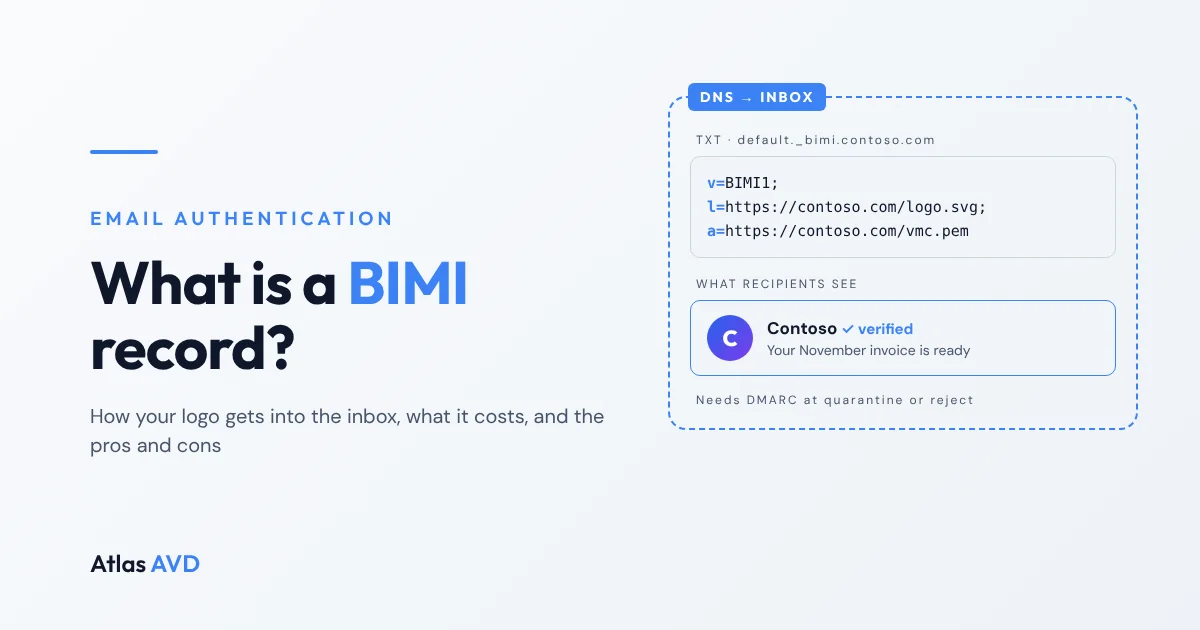
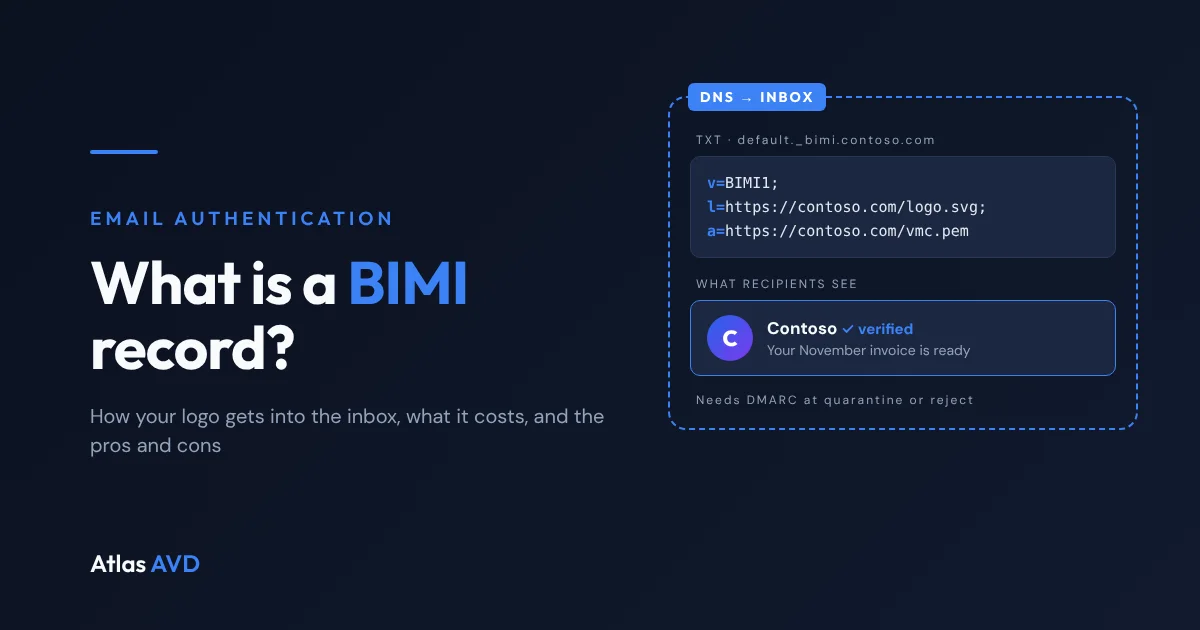
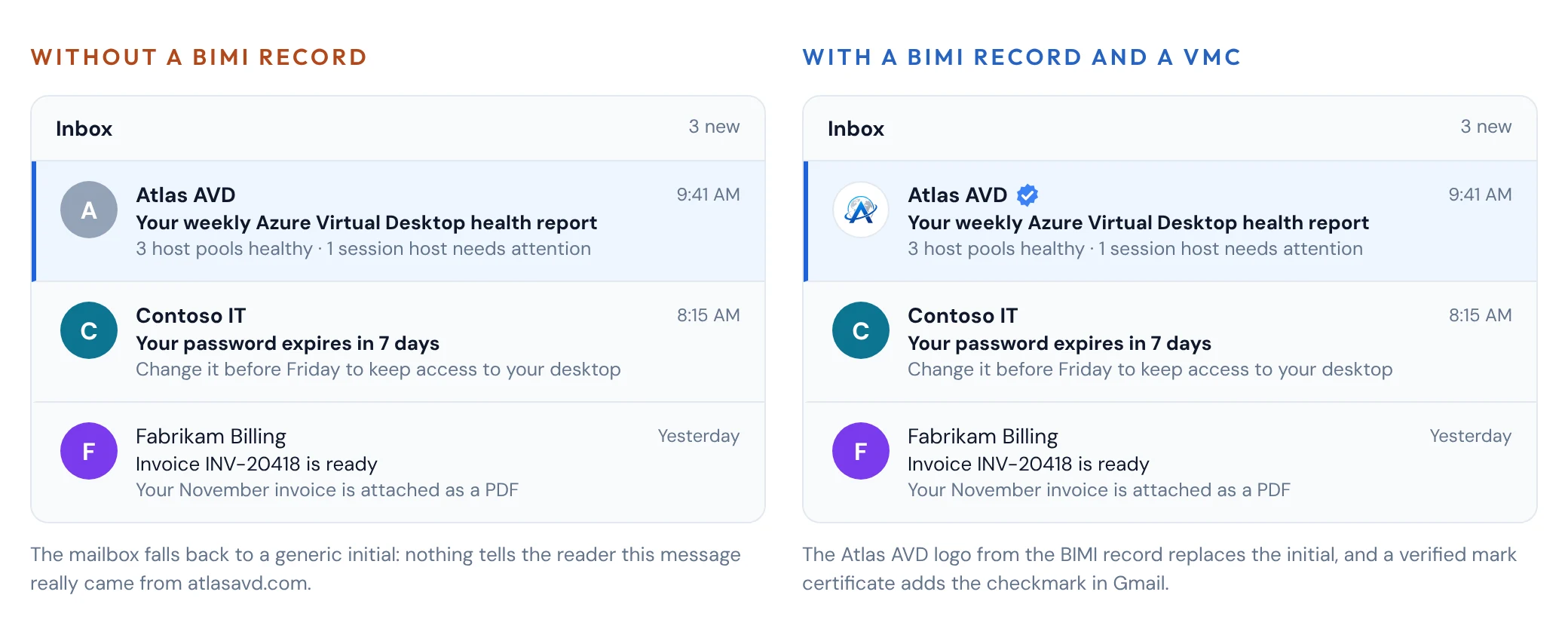
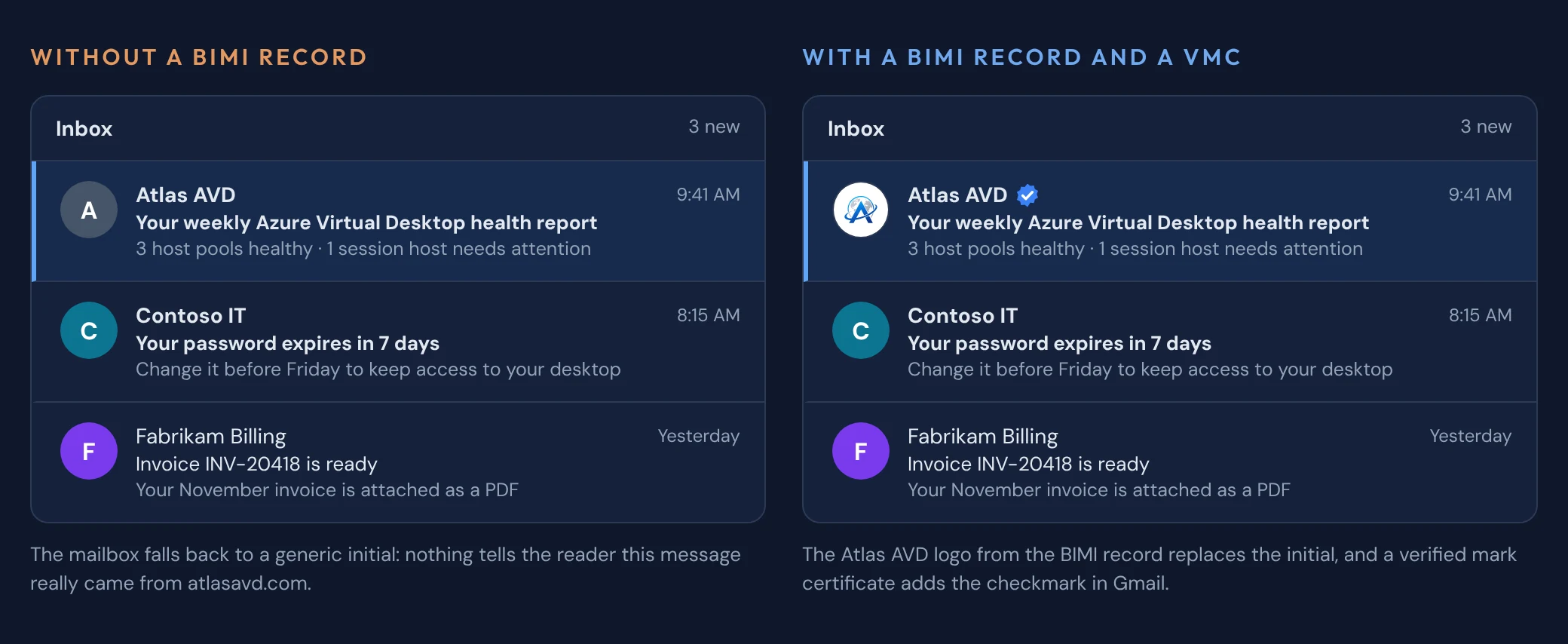
A BIMI record (Brand Indicators for Message Identification) is a DNS TXT record that tells supporting mailboxes where to find your brand logo, so they can show it next to messages from your domain instead of a generic initial. It only works on top of strong email authentication: your domain needs DMARC enforced at quarantine or reject, and Gmail and Apple Mail also require a paid mark certificate that proves the logo is yours.
The short version: BIMI is optional and affects how your mail looks, not whether it's delivered. It's worth doing once SPF, DKIM and DMARC are solid and you send enough mail that brand recognition matters. Microsoft's Outlook and Microsoft 365 mailboxes don't display BIMI logos, so if your recipients are mostly on Outlook, you'll see little benefit.
You can check whether your domain already publishes a BIMI record, and whether its DMARC policy is ready for one, with our free Email Domain Health Check.
What a BIMI record looks like
The record lives at default._bimi. in front of your domain. For contoso.com, that's a TXT record at default._bimi.contoso.com:
v=BIMI1; l=https://contoso.com/brand/logo.svg; a=https://contoso.com/brand/vmc.pem
| Tag | What it holds | Required? |
|---|---|---|
v=BIMI1 | The version. Always first. | Yes |
l= | An https link to your logo, as an SVG Tiny Portable/Secure (SVG Tiny PS) file | Yes, to show a logo |
a= | An https link to your mark certificate (a VMC or CMC), as a PEM file | Required by Gmail and Apple Mail |
default is the selector receivers use unless a message asks for another one. A record with both tags empty (v=BIMI1; l=; a=;) is a deliberate statement that the domain doesn't want a logo shown. If a subdomain has no record of its own, receivers fall back to the one on your organizational domain.
How BIMI works when a message arrives
- A receiving mailbox checks the message's SPF, DKIM and DMARC.
- If DMARC passes and the domain's policy is enforced, it looks up the BIMI record.
- It fetches the logo and, where it requires one, validates the certificate against it.
- If everything checks out, and the sender has a good reputation with that provider, the logo appears in the inbox.
Each mailbox provider decides for itself whether to show the logo. Publishing a valid record makes you eligible; it doesn't guarantee the logo appears.
What you need before BIMI does anything
DMARC at enforcement. Your DMARC policy must be p=quarantine or p=reject, applied to all mail (pct=100, which is the default when the tag is missing), and the subdomain policy (sp=) must not be none. At p=none, receivers ignore your BIMI record. For most organizations this is the real work, and it's the part that actually protects your domain from spoofing.
An SVG Tiny PS logo. A normal SVG exported from a design tool won't pass. The BIMI profile requires a square image, no scripts or external references, and a title element. Keep it small (the BIMI Group recommends under 32 KB) and give it a solid background, because mailboxes crop logos to a circle or rounded square.
A mark certificate, for Gmail and Apple Mail. There are two kinds:
| Verified Mark Certificate (VMC) | Common Mark Certificate (CMC) | |
|---|---|---|
| Proves | You own the logo as a registered trademark | You've used the logo publicly for at least a year |
| Trademark needed | Yes | No |
| Gmail | Logo plus the blue verified checkmark | Logo, no checkmark |
| Apple Mail | Supported | Not supported at the time of writing |
| Typical cost | Roughly $1,000 to $1,500 a year | Usually somewhat less than a VMC |
Both are issued by a small number of certificate authorities after an identity check, and both renew every year.
Which mailboxes show BIMI logos
| Mailbox | Shows BIMI logos? | Certificate needed |
|---|---|---|
| Gmail | Yes | VMC or CMC |
| Apple Mail and iCloud Mail | Yes | VMC |
| Yahoo Mail and AOL | Yes | Not always; can show logos for senders with a good reputation |
| Fastmail, Zoho Mail, GMX, La Poste and others | Yes, varies by provider | Varies |
| Outlook, Outlook.com and Microsoft 365 | No | Not applicable |
Support changes over time, so check the BIMI Group's current list before you plan around a particular mailbox.
The pros of BIMI
- Recognition in a crowded inbox. A familiar logo beside the sender name is easier to spot than a grey initial, which can help people open the mail they're expecting from you.
- A visible trust signal. Only domains that pass DMARC at enforcement can show the logo, and Gmail's checkmark adds a verified badge, which makes look-alike phishing a little easier for recipients to spot.
- It pushes you to finish DMARC. The biggest benefit is often indirect: BIMI gives marketing a reason to fund the move to
p=reject, which is what actually stops attackers from sending as your domain. - One record, every message. Once it's published, every message that passes DMARC is eligible, including invoices, receipts and support replies, not just campaigns.
The cons of BIMI
- It costs money every year. Gmail accepts a VMC or a CMC, Apple Mail accepts only a VMC, and a VMC also needs a registered trademark, which can take months to obtain if you don't have one.
- Microsoft mailboxes ignore it. For a business-to-business sender whose recipients are mostly on Microsoft 365, most people will never see the logo.
- No guarantee of display. Providers can withhold the logo based on volume or reputation, so a valid setup can still show nothing for a small sender.
- It doesn't improve deliverability directly. BIMI changes how mail looks, not whether it lands in the inbox. Any deliverability gain comes from the DMARC enforcement underneath it.
- The logo format is fussy. Converting a logo to SVG Tiny PS and keeping it valid takes care, and a broken logo or expired certificate silently stops the logo appearing.
- It's still a draft standard. BIMI is maintained by the BIMI Group and an IETF draft rather than a finished RFC, so details can still change.
Is BIMI worth it for your domain?
| Your situation | Our advice |
|---|---|
DMARC is missing or at p=none | Not yet. Fix SPF, DKIM and DMARC first; BIMI does nothing until DMARC is enforced. |
| You send to consumers on Gmail, Apple Mail or Yahoo | Usually yes. That's where the logo shows, and recognition matters most. |
| Your recipients are mostly on Microsoft 365 | Probably not. Few of them will ever see it. |
| You have a registered trademark and an enforced DMARC policy | Yes, if the yearly certificate cost fits your budget; a VMC gets you the Gmail checkmark. |
| You have no trademark | A CMC gets the logo into Gmail; Apple Mail will still show an initial. |
How to set up BIMI
- Get DMARC to enforcement. Publish DMARC at
p=nonewith aruaaddress, review the reports until all your legitimate senders pass SPF or DKIM, then move top=quarantineandp=reject. - Prepare your logo as a square SVG Tiny PS file and host it on an https URL you control.
- Buy a VMC or CMC if you want the logo in Gmail and Apple Mail, and host the PEM file on https as well.
- Publish the TXT record at
default._bimi.yourdomainwith thel=anda=links. - Check it. Run your domain through the Email Domain Health Check: the BIMI card confirms the record, the logo link, the certificate link and whether your DMARC policy is enforced.
FAQ
What does BIMI stand for?
Brand Indicators for Message Identification. It's a standard that lets a domain owner publish a logo in DNS for supporting mailboxes to show beside authenticated mail.
Does BIMI improve email deliverability?
Not directly. BIMI controls how your mail looks once it arrives. The deliverability benefit comes from the enforced DMARC policy BIMI requires, which makes your mail easier for receivers to trust.
Do I need a VMC for BIMI?
Gmail and Apple Mail need a certificate: Gmail accepts a VMC or a CMC, and Apple Mail requires a VMC. Some providers, such as Yahoo, may show a logo from the BIMI record alone for senders with a good reputation.
Does Outlook support BIMI?
No. Outlook, Outlook.com and Microsoft 365 mailboxes don't display BIMI logos at the time of writing, so recipients there won't see your logo.
Why isn't my BIMI logo showing?
The usual causes are a DMARC policy at p=none or below pct=100, a logo that isn't valid SVG Tiny PS, a missing or expired certificate, or a provider that withholds logos for low-volume senders. Our Email Domain Health Check flags the DNS-side problems.
Does a BIMI record affect my email health grade?
No. In our Email Domain Health Check, BIMI is reported but never scored, because it's optional. A broken BIMI record is listed as something to fix; not having one isn't.
Last updated 17 November 2026. Mailbox support and certificate details are summarized from public information as of that date and change over time; confirm current requirements with the BIMI Group and each mailbox provider before you buy a certificate.