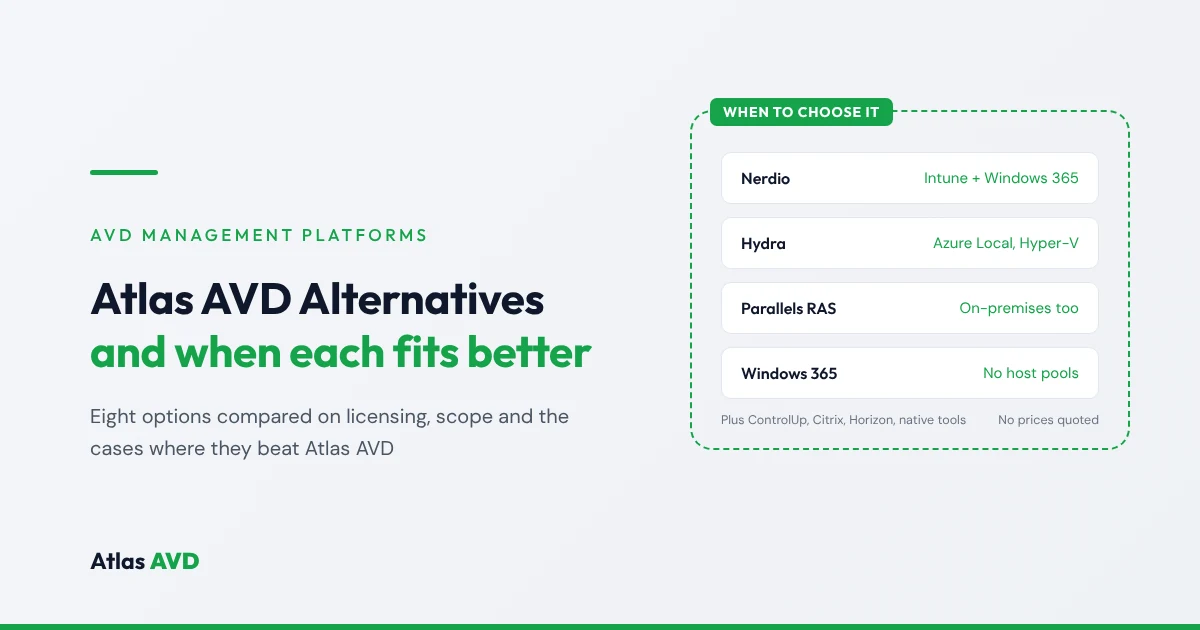
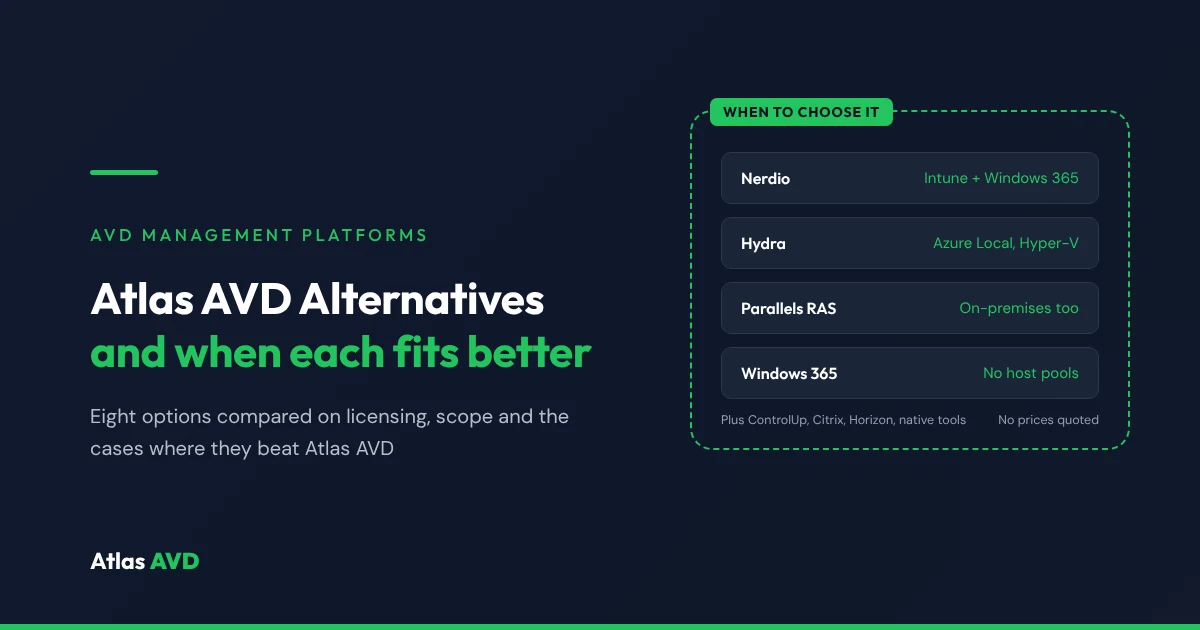
The alternatives teams most often compare Atlas AVD against are Nerdio Manager, Hydra, ControlUp, Parallels RAS, Citrix, Omnissa Horizon, Windows 365 and Microsoft's native AVD tooling. Only Nerdio and Hydra are like-for-like: they deploy and run Azure Virtual Desktop from your own Azure subscription, as Atlas AVD does, but both license by user count. The rest solve a different problem: ControlUp monitors sessions but doesn't build them, Parallels RAS, Citrix and Horizon add a second delivery platform on top of AVD, Windows 365 gives up multi-session pooling, and native tooling leaves you to stitch it together yourself.
Last updated 19 November 2026.
The short version: Atlas AVD is the only option on this list that is an all-in-one platform: AVD management, device management and remote support, documentation, ticketing and email signatures in one console, at one flat monthly price per tenant with unlimited AVD users and technicians. Per-user and per-concurrent-user tools (Nerdio, Hydra, Parallels RAS, Horizon) grow your bill with every hire. Hybrid platforms (Citrix, Horizon, Parallels RAS) add licensing and infrastructure an Azure-first estate doesn't need. ControlUp watches the estate but still needs a manager. Windows 365 costs more per user than pooled hosts for most workforces. And native tooling costs you staff time instead of license fees. You can try every Atlas AVD feature free for 30 days.
Why teams choose Atlas AVD
Atlas AVD is an Azure Virtual Desktop management platform that deploys into your own Azure subscription: the management app, its database, Key Vault and automation run as resources in your tenant, so your desktops and their data never leave your environment.
- A price that doesn't grow with headcount. One flat monthly price per licensed Azure tenant, with unlimited AVD users, host pools, session hosts and technicians. Hiring, seasonal peaks and new MSP clients' users never add to your Atlas bill.
- Every AVD feature on one plan. No editions to upgrade through to unlock autoscaling, imaging or analytics.
- Image updates you don't have to babysit. Golden images publish to Azure Compute Gallery and roll out in stages, stopping and rolling back automatically if host health drops.
- Deployments that don't fail halfway. The deployment wizard checks Azure quota and network readiness before anything provisions.
- Lower Azure spend. Predictive autoscaling with DrainGuard and Adaptive Density, plus Atlas Intelligence rightsizing and idle-host recommendations that show what each idle host costs to leave running.
- More than AVD in the same console. FSLogix management, WinGet app catalogs per host pool, logon analytics, the Configuration Matrix for settings inheritance and Atlas Advisor, alongside Atlas Reach for physical Windows devices and remote support, Atlas Ink email signatures, Atlas Vault for documentation and Atlas Flow for ticketing.
- Built for MSPs. The per-tenant MSP Capabilities upgrade adds Atlas Command, one console across every client tenant, with cross-tenant analytics and white-label branding.
- A free plan, not just a trial. The Community plan is free for one Azure tenant and one host pool, and the 30-day trial includes every feature with no credit card.
Why Atlas AVD is better: one platform instead of a stack of tools
Every alternative on this list does one job. Pick Nerdio or Hydra and you still buy remote support, documentation, ticketing and email signatures from someone else. Pick ControlUp and you still need a manager underneath it. Pick native tooling and you build the console yourself. Each extra product is another bill, another login, another agent and another integration to keep working.
Atlas AVD is the all-in-one platform for running Azure Virtual Desktop and the Windows estate around it, in one console, deployed in your own Azure tenant:
| The job | With Atlas AVD | With the alternatives |
|---|---|---|
| AVD deployment, scaling and imaging | Atlas AVD | Nerdio, Hydra or native tooling |
| Session and logon analytics | Atlas AVD logon analytics and Atlas Intelligence | ControlUp or AVD Insights, bought or built separately |
| Azure cost recommendations | Atlas Intelligence rightsizing and idle-host costs | A separate FinOps tool or spreadsheets |
| Physical Windows devices and remote support | Atlas Reach | A separate RMM and remote support tool |
| IT documentation and credentials | Atlas Vault | A separate documentation platform |
| Ticketing | Atlas Flow (in preview) | A separate PSA or helpdesk |
| Email signatures | Atlas Ink | A separate signature tool |
| Answers and how-to help for technicians | Atlas Advisor | Vendor docs and support tickets |
| Every client tenant in one view | Atlas Command (MSP Capabilities) | One console per tool, per client |
What that means in practice:
- One bill. One flat price per tenant instead of a stack of per-user and per-device licenses that each grow on their own.
- One console and one login for technicians, with one set of roles and one audit trail.
- No integrations to babysit. A device, its user's desktop, its documentation and its ticket are already in the same place, so nothing has to sync between products.
- Your data stays in your tenant. The whole platform runs as resources in your own Azure subscription, not spread across several vendors' clouds.
The eight alternatives, and how they compare
Competitor details come from each vendor's own pages, checked on 9 November 2026, and are listed at the end. We don't quote competitor prices, because they change and many are set by quote.
1. Nerdio Manager
Nerdio sells Nerdio Manager for Enterprise, which manages AVD, Windows 365 and Intune, and Nerdio Manager for MSP, which adds multi-tenant and Microsoft 365 management. It covers autoscaling, image and session host lifecycle, auto-healing and role-based access, deploys into your own Azure subscription and is licensed per user, per month, in editions.
Where it falls short: every user you add raises the bill on top of Azure, the MSP edition counts assigned users whether or not they sign in, and features are split across editions. Choose Atlas AVD instead when: you want AVD management that costs the same at 50 users as at 5,000, every AVD feature without an edition upgrade, and image rollouts that roll themselves back. See Atlas AVD vs Nerdio row by row, with a savings calculator.
2. Hydra
Hydra, created by Marcel Meurer at ITProCloud and acquired by Login VSI in 2025, is a lean, portal-driven management layer for AVD and Windows 365. It deploys into your own Azure subscription and covers autoscaling, image lifecycle with rollback, role-based access and multi-tenant use. Login VSI licenses it by peak concurrent users.
Where it falls short: your bill tracks your busiest hour, so growth and peak days cost more, and it's a narrower toolset that leaves devices, documentation and ticketing to other products. Choose Atlas AVD instead when: you want a flat bill per tenant whatever your concurrency, a deployment wizard with pre-flight checks, Atlas Intelligence cost recommendations and the rest of your Windows estate in one console. See Atlas AVD vs Hydra and Hydra's per-concurrent-user licensing vs flat-rate pricing.
3. ControlUp
ControlUp is an agent-based digital employee experience (DEX) platform that monitors AVD and Windows 365 sessions in real time, with remediation actions, a script library and synthetic logon tests.
Where it falls short: it doesn't build host pools, images or app delivery, so you still need a management platform underneath it and pay for two products. Choose Atlas AVD instead when: you want deployment, scaling, imaging and logon analytics in one product rather than a monitoring layer on top of another one. See Atlas AVD vs ControlUp.
4. Parallels RAS
Parallels RAS is an application and desktop delivery platform with its own broker, gateway and client. It can manage AVD host pools and also publishes from on-premises hosts. It's licensed per concurrent user, with Microsoft licensing on top.
Where it falls short: you run and patch its brokers and gateways yourself, and pay a second per-user license on top of the AVD rights you already own. Choose Atlas AVD instead when: your desktops are in Azure and you want AVD managed natively, with no extra delivery infrastructure. See AVD vs Parallels RAS.
5. Citrix
Citrix offers its HDX protocol and unified management across AVD, Windows 365 and on-premises desktops, sold under its platform subscriptions.
Where it falls short: it adds a second licensing layer and platform over AVD, which is hard to justify once your desktops live in Azure. Choose Atlas AVD instead when: you're moving off legacy VDI and want Microsoft's own AVD stack managed well, without a second platform bill. See Azure Virtual Desktop vs Citrix.
6. Omnissa Horizon
Omnissa Horizon, formerly VMware Horizon, runs as self-managed Horizon 8 on-premises or in VMware-based clouds, or on Azure capacity through the Omnissa-hosted Horizon Cloud Service, next-gen. It's licensed as an Omnissa subscription per named or concurrent user.
Where it falls short: it carries its own subscription, client and infrastructure, built for estates that are still largely on-premises. Choose Atlas AVD instead when: you're leaving on-premises VDI behind and want AVD managed natively in Azure on a flat price. See Azure Virtual Desktop vs VMware Horizon.
7. Windows 365
Windows 365 replaces AVD with Microsoft-managed Cloud PCs, each a dedicated Windows desktop for one user, billed at a fixed monthly price per user. There are no host pools to run, but also no Windows multi-session pooling.
Where it falls short: every user needs their own Cloud PC running whether or not they're working, so part-time, shift and seasonal workforces pay for idle desktops. Choose Atlas AVD instead when: you want pooled multi-session hosts and autoscaling to keep cost per user down, with Atlas AVD handling the host pools and images for you. See AVD vs Windows 365.
8. Microsoft's native tooling
You can run AVD with no third-party platform: scaling plans, session host update, Azure Compute Gallery and Azure VM Image Builder for images, AVD Insights for monitoring and the AVD Landing Zone Accelerator for deployment.
Where it falls short: these are separate services you stitch together, script and maintain yourself, with no single console, no multi-tenant view and no cost recommendations. The license is free; the staff time isn't. Choose Atlas AVD instead when: you want those same Azure building blocks run for you from one console, or you manage more than one tenant. Atlas AVD's free Community plan costs nothing for one tenant and one host pool. Our guide to the best AVD management tools lists what each native tool covers.
Atlas AVD alternatives at a glance
| What it is | Where it runs | Licensing model | Extra cost or effort vs Atlas AVD | |
|---|---|---|---|---|
| Atlas AVD | AVD management platform | Your Azure subscription | Flat per tenant, unlimited AVD users; free Community plan | (the baseline) |
| Nerdio Manager | AVD, Windows 365 and Intune management | Your Azure subscription | Per user per month, in editions | Bill grows with every user |
| Hydra | AVD and Windows 365 management | Your Azure subscription | Peak concurrent users | Bill grows with peak usage |
| ControlUp | DEX monitoring and remediation | ControlUp's platform, agents on hosts | Subscription; quote | Still needs a management platform |
| Parallels RAS | Hybrid delivery platform | Infrastructure you run | Per concurrent user, plus Microsoft licensing | Brokers and gateways to run |
| Citrix | Hybrid delivery platform | Citrix cloud plus your infrastructure | Platform subscription | Second platform over AVD |
| Omnissa Horizon | Hybrid VDI platform | Infrastructure you run, or Horizon Cloud Service | Subscription per named or concurrent user | Second platform over AVD |
| Windows 365 | Microsoft-managed Cloud PCs | Microsoft's cloud | Fixed per user per month | No pooling, so idle desktops still cost |
| Native Microsoft | Azure services | Azure | Included; you pay for Azure resources | Staff time to build and maintain |
How to compare them fairly
- Price the same estate with each shortlisted tool, using your real user counts, peak concurrency and number of tenants, and project it over three years of growth.
- Count the second bills: monitoring add-ons, delivery infrastructure and the staff time native tooling needs.
- Pilot one host pool for two weeks, including an image update, a scale-down at night and a user-facing change. The 30-day Atlas AVD trial includes every feature.
- Remember your Azure resources stay put. Host pools, session hosts, images and FSLogix shares are Azure resources, so moving to Atlas AVD means building the management configuration around them, not rebuilding the desktops.
FAQ
What is the best alternative to Atlas AVD?
For like-for-like AVD management, the closest alternatives are Nerdio and Hydra, but both charge by user count while Atlas AVD charges one flat price per tenant with unlimited AVD users. ControlUp is a monitoring layer rather than a manager, Parallels RAS, Citrix and Omnissa Horizon add a second platform over AVD, Windows 365 drops multi-session pooling, and native tooling trades license fees for staff time.
Is Atlas AVD cheaper than Nerdio?
For most estates, yes, and the gap widens as you grow. Atlas AVD is one flat price per tenant with unlimited AVD users, while Nerdio charges per user, per month on top of Azure. The Atlas AVD vs Nerdio calculator shows the difference for your own user count, and current Atlas prices are on the pricing page.
Is there a free alternative to Atlas AVD?
Atlas AVD has its own free Community plan for one Azure tenant and one host pool, with unlimited technicians and the full Atlas Advisor. Microsoft's native AVD tooling carries no extra license, but you build and maintain it yourself and still pay for Azure resources and Log Analytics ingestion.
How hard is it to move to Atlas AVD from another tool?
Atlas AVD runs in your own Azure subscription and manages standard AVD resources, so your session hosts, images and FSLogix shares stay where they are. The cleanest path is a pilot host pool built by Atlas AVD alongside your current estate, then moving users across once you've compared logon times, scaling and Azure cost.
Competitor details are drawn from each vendor's public pages, checked on 9 November 2026: Nerdio Manager for Enterprise, Nerdio Manager for MSP and Nerdio enterprise pricing; Hydra for AVD and ITProCloud Hydra; ControlUp for Azure Virtual Desktop; Parallels RAS for AVD; Citrix for Azure Virtual Desktop; Omnissa Horizon 8 architecture and Horizon Cloud Service next-gen architecture; Microsoft Learn on Windows 365, autoscale scaling plans and session host update. They're summarized in good faith; confirm current features and terms with each vendor. Product names are trademarks of their owners; this article is not affiliated with or endorsed by any of them.